
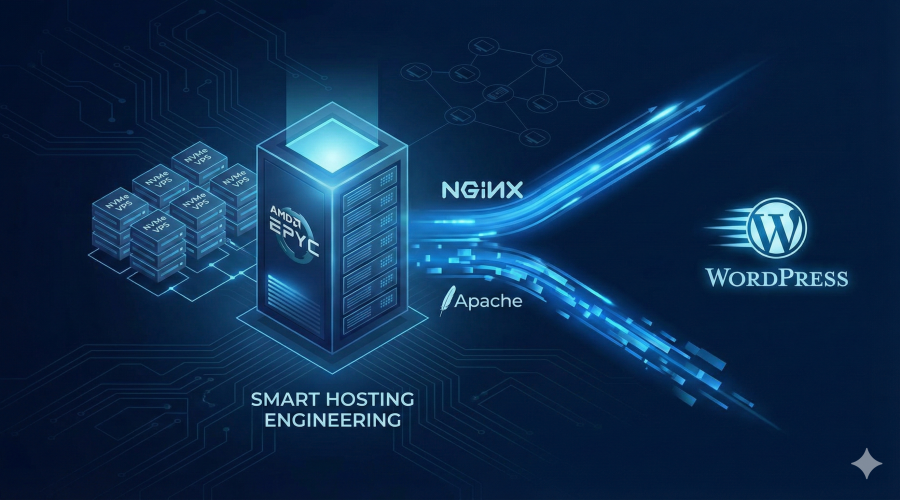
The Engineering of Speed. A Comprehensive Guide to High-Performance Hosting, NVMe Infrastructure, and Why Cheap Doesn't Mean Low Quality.
Let us be honest for a moment. Nobody wakes up in the morning excited to buy web hosting. You wake up excited about your business, your blog, your dropshipping store, or your new application. Hosting is just the utility bill of the internet. It is the invisible foundation. You only notice it when it breaks, or worse, when it is slow.
Here is the hard truth that many business owners learn too late. That invisible foundation dictates your revenue. Amazon found that every 100 milliseconds of latency cost them one percent in sales. Google punishes slow sites in search rankings. Your customers simply leave if a page takes more than three seconds to load.
At Yhost, we have spent years dismantling the traditional hosting model. We realized that the industry is filled with unlimited promises that are technically impossible to keep. We stopped chasing marketing buzzwords and started chasing physics. We embraced Smart Engineering.
This guide is not just a pitch for our services. It is a deep dive into the mechanics of the modern web. We are going to explain exactly what happens when a user clicks a link on your site. We will explore why traditional hosting stacks choke under pressure. We will detail why we specifically chose the technology we use—NVMe, NGINX, AMD EPYC, and Redis—to solve these problems.
By the end of this guide, you will understand the difference between hosting and infrastructure. You will know exactly why a cheap generic host might be the most expensive purchase you ever make. Most importantly, you will see how professional engineering allows us to give you enterprise-level speeds without the enterprise price tag.
The Hardware Reality Check
To understand speed, we have to start at the bottom with the physical storage.
For decades, the web ran on Hard Disk Drives or HDDs. These are the drives with spinning magnetic platters and a mechanical arm that physically moves to read data. Imagine a record player. To play a specific song, the needle has to move to the right spot. It takes time. In computing terms, this mechanical movement is an eternity. This is called latency.
Then came SSDs or Solid State Drives via the SATA interface. They removed the moving parts, which was a massive leap forward. However, they were still limited by the SATA cable. This is a protocol designed for spinning disks. It was like putting a Ferrari engine in a tractor.
Enter NVMe. Non-Volatile Memory Express.
NVMe is not just a faster drive. It is a completely different language of storage. It connects directly to the server's CPU via the PCIe interface. It bypasses the bottlenecks of legacy storage protocols.
Why does this matter for your WordPress site or Laravel app?
Modern websites are essentially database machines. Every time a visitor loads your homepage, the server has a massive job to do.
- It looks up the content in the database
- It finds the appropriate images
- It loads the CSS and JavaScript files
- It processes the PHP scripts
This generates hundreds, sometimes thousands, of tiny read and write operations per second. Traditional SSDs choke on this queue. The CPU sits idle while waiting for the data to arrive from the drive. Your visitor sees a white screen.
At Yhost, we use 100% Enterprise NVMe Storage. We do not use NVMe just for caching. We use it for your operating system, your files, and your databases. This eliminates the I/O bottleneck entirely. The data is fed to the processor instantly. This is why your WordPress dashboard feels snappy. This is why your checkout page loads immediately. We do not charge extra for this because we believe that in 2026, offering anything less than NVMe is negligent.
Learn more about NVMe features here.
The Brains of the Operation. AMD EPYC Processors.
Storage gets the data to the processor, but the processor has to do the math. In the hosting world, you often see terms like vCPU or Core with no context. But not all cores are created equal.
A core from a ten-year-old budget server is vastly different from a modern enterprise core. Many budget hosts use older hardware to keep costs down. They oversell these weak cores by cramming thousands of users onto a single machine. When one user gets a traffic spike, everyone else slows down. This is the noisy neighbor effect.
We chose AMD EPYC processors for our infrastructure in Germany. We chose AMD because in recent years they have leapfrogged the competition in high-performance server computing. EPYC processors offer incredible density and high frequency.
High frequency matters for PHP. The language WordPress, Magento, and many others are built on is primarily single-threaded. This means a single request generally runs on a single core. Having 64 slow cores does not help a single request load faster. You need fast cores.
By combining NVMe storage with high-frequency AMD EPYC processors, we ensure that the hardware is never the bottleneck. We provide the raw power. It is up to the software to use it effectively.
The Software Stack
Having a fast car does not matter if you are stuck in traffic. The web server software is the traffic controller.
Apache vs NGINX. The Waiter Analogy.
For a long time, Apache was the undisputed king of the web. It is reliable, flexible, and compatible with everything. But it has a flaw. It was designed in an era when the web was smaller. Apache handles connections using a process-based model.
Imagine a restaurant which represents your server. In an Apache restaurant, every time a customer or visitor walks in, the restaurant hires a dedicated waiter just for that table. That waiter stands there the entire time, even if the customer is just reading the menu or eating slowly. If you have 100 tables and 100 waiters, the restaurant is full. The 101st customer has to wait outside until someone leaves. This eats up RAM incredibly fast.
NGINX changed the game. It uses an event-driven architecture.
In the NGINX restaurant, you have one super-fast waiter on roller skates. He takes an order at Table 1, drops it at the kitchen, zips to Table 2 to pour water, then back to the kitchen to pick up food for Table 3. He handles hundreds of tables simultaneously without breaking a sweat. He does not sit around waiting.
At Yhost, we use an NGINX-optimized stack. We place NGINX in front of your website. It handles the static heavy lifting. Images, CSS files, and JavaScript are served instantly from memory by NGINX. It bypasses the heavy processing logic.
This frees up your PHP workers to do what they do best which is process dynamic content. The result is that your site can handle significantly more concurrent traffic on the same hardware compared to a traditional Apache setup. You stop losing customers during traffic spikes.
The Secret Weapon. Redis Object Caching.
If NVMe is the foundation and NGINX is the traffic controller, Redis is the short-term memory.
WordPress is database-heavy. To render your homepage, WordPress asks the database multiple questions. What is the site title? What are the latest 5 posts? Who is the author? What is the featured image?
The database has to find this info on the disk and calculate the result. Even NVMe takes microseconds to do this.
Redis stores the result of that calculation in the server's RAM. RAM is thousands of times faster than any disk.
So, the second time someone visits your homepage, WordPress does not ask the database. It asks Redis. Redis says "Here is the data because I already have it." The page loads instantly.
Many hosts charge extra for Redis or make it complicated to set up. We include Redis support on our plans because we know it is essential for performance. This is especially true for WooCommerce stores. If you are running an online shop without object caching, you are forcing your server to do redundant work for every single shopper. That is inefficient engineering.
The Truth About Unlimited Hosting
You have seen the ads. Unlimited Storage. Unlimited Bandwidth. Unlimited Websites. All for the price of a cup of coffee.
It sounds great. It is also technically impossible.
There is no such thing as an unlimited hard drive. There is no such thing as an unlimited network pipe. So how do they get away with it?
They cap you on the things you do not see.
They limit your inodes which is the number of files you can have. They limit your I/O speed or how fast you can read and write data. Most critically, they limit your CPU usage and PHP Workers.
A PHP Worker is a process that executes your website's code. If you have "Unlimited Bandwidth" but only 2 PHP workers, your site can only handle 2 people clicking a link at the exact same second. The 3rd person gets an error.
At Yhost, we believe in Smart Transparency. We do not sell "Unlimited" fairy tales. We sell defined resources.
- We tell you exactly how much NVMe storage you get
- We define the bandwidth
- We allocate generous RAM and CPU limits that allow your site to breathe
Our philosophy is that it is better to have 50GB of ultra-fast guaranteed NVMe storage than "Unlimited" slow storage that gets your account suspended the moment you actually try to use it. We engineer for stability rather than deceptive marketing.
WordPress and WooCommerce Specialized Needs
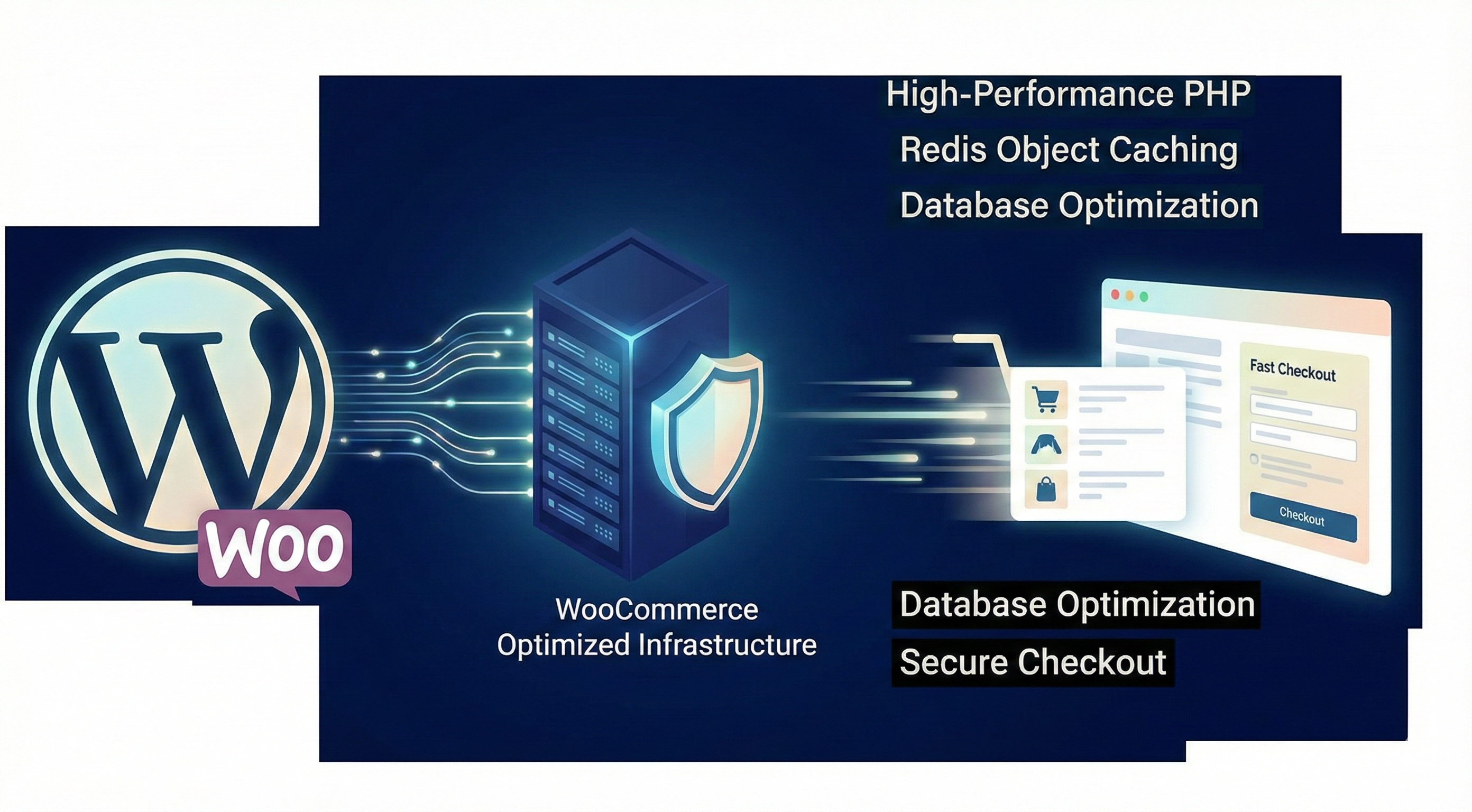
WordPress powers over 40% of the web. It is fantastic, but it can be heavy. WooCommerce is even heavier.
A static blog is easy to cache. You take a picture of the page and show it to everyone. But a WooCommerce store is dynamic.
- The shopping cart is unique to every user
- The user account page is unique
- Inventory levels change in real-time
You cannot cache the checkout page. If you do, one customer might see another customer's credit card info. That is a disaster.
This means WooCommerce relies heavily on raw PHP processing power and database performance. This is where our Smart Stack shines.
We configure NGINX to explicitly ignore the caching of cart and checkout pages to ensure data integrity. Our MariaDB servers are tuned to handle the complex queries that WooCommerce generates. We offer the latest PHP versions. Upgrading from PHP 7.4 to PHP 8.1 or 8.2 can double your speed immediately. We make switching versions a single click in our control panel.
If you are running a serious store, you cannot afford to be on a server that is overloaded with thousands of idle blogs. Our WooCommerce plans allocate higher limits of RAM and PHP workers specifically to prevent cart abandonment. When a customer clicks "Pay," it should happen instantly. Any delay gives them a chance to rethink the purchase. Speed is trust.
Cloud VPS vs Web Hosting. Which One Do You Need?
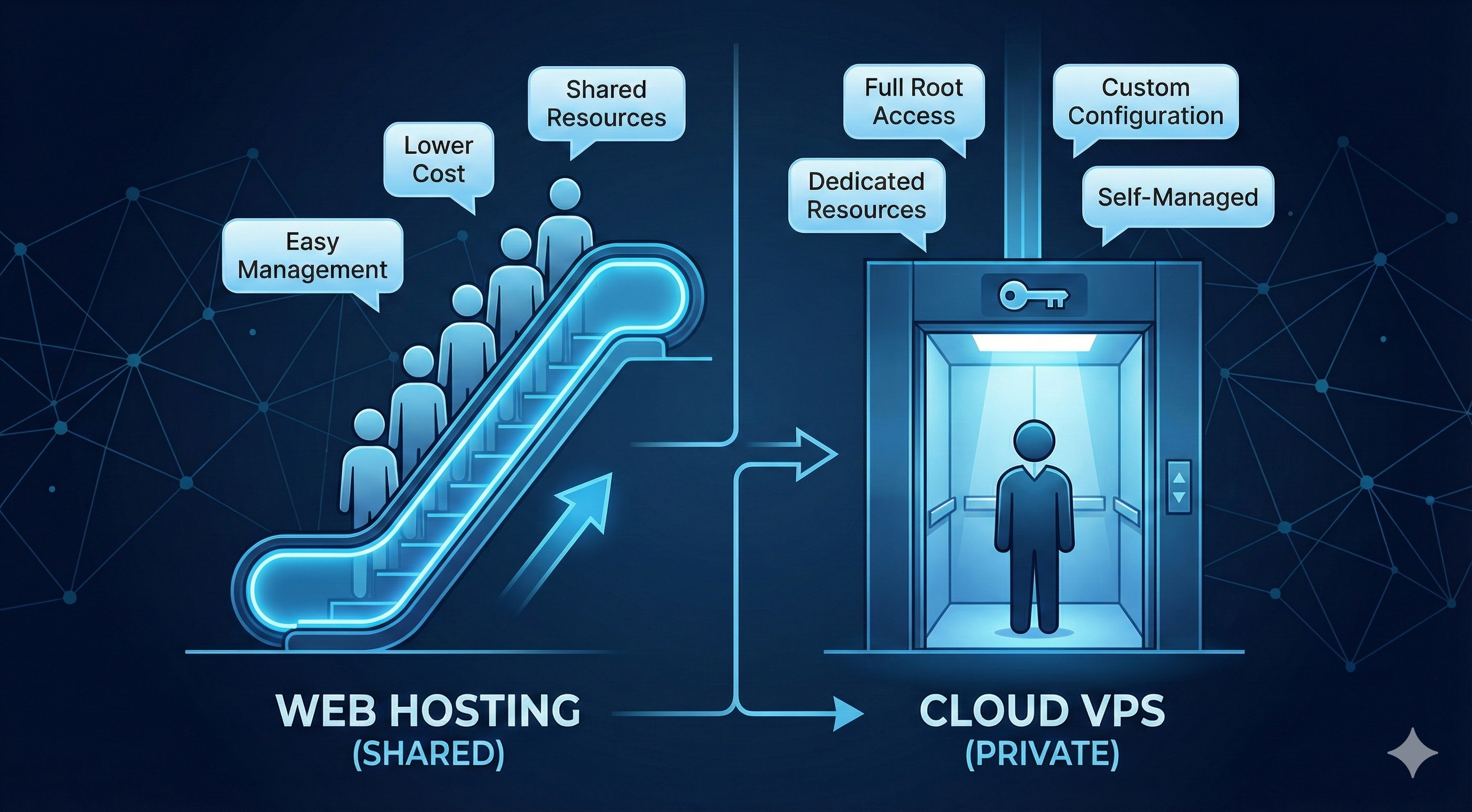
We offer both Smart Web Hosting and Cloud VPS. Clients often ask us which one they need. The best way to understand the difference is the escalator versus the private elevator analogy.
The Escalator. Web Hosting.
Think of Web Hosting like taking an escalator in a busy shopping mall.
The advantages are clear. It is easy. You just step on by uploading your files, and it takes you where you want to go. The mall management handles maintenance, greasing the gears, and security. It is cheap.
The downsides are also clear. You are sharing the escalator with others. If a big group blocks the way, you slow down. You cannot make the escalator go faster just for you. You cannot repaint the escalator.
The Private Elevator. Cloud VPS.
Think of a Cloud VPS or Virtual Private Server as a private elevator.
The advantages are power and control. It is yours. You have the key. You decide who gets in. You can go as fast as the engine allows. You have dedicated space including RAM and CPU that nobody else can touch. You have Root Access. You can repaint the walls, change the buttons, or install custom software.
The downside is responsibility. You are responsible for pressing the buttons. If the elevator gets stuck between floors because you pressed the wrong sequence, you have to fix it or pay us to help. This is the Self-Managed aspect.
You need Web Hosting if you are running a blog, a portfolio, a standard business site, or a small to medium shop. It is also for you if you do not know what SSH or Linux commands are and you want us to handle security patches, backups, and updates.
You need a Cloud VPS if you are a developer who needs specific software versions like Node.js or Docker. It is for you if you have a high-traffic site that exceeds shared resource limits or if you need strict data isolation for compliance.
At Yhost, our Cloud VPS in Germany provides the raw power of AMD EPYC and NVMe with KVM virtualization. This ensures that your resources are truly isolated. But remember that with great power comes great responsibility. VPS plans are Self-Managed by default to keep costs low for professionals. We provide the car while you drive it. If you need a chauffeur, we offer Managed Services as an add-on.
Security is Not an Add-On
In the hosting world, security is often treated as an upsell. Providers ask you to pay extra for protection. We disagree. Security should be baked into the infrastructure.
Network Level Protection
Our data centers in Germany are protected by advanced DDoS mitigation appliances. We scrub bad traffic before it even hits your server. This protects you from attackers trying to knock your site offline by flooding it with fake requests.
Account Isolation
On our shared hosting, we use CloudLinux and CageFS. This encapsulates each user in their own virtual cage. Even if another user on the server gets hacked because they used a weak password, the hacker cannot jump from their account to yours. Your files are invisible to them.
The Spam Problem and Our Strict Stance
You might notice in our Terms that we block Port 25 for email sending on our VPS servers by default. Some users find this annoying. Let us explain why this is actually a good thing for you.
Cheap VPS providers often attract spammers. These spammers send millions of junk emails. This causes the IP addresses of the hosting provider to get blacklisted by Gmail, Outlook, and Yahoo. If you are on the same network range as a spammer, your legitimate business emails start going to the Spam folder.
By strictly vetting who can send email and blocking Port 25 by default, we keep our IP reputation pristine. We maintain a Zero Tolerance Policy for spam. This ensures that when you send an invoice or a newsletter to your client, it actually arrives. We protect the neighborhood values.
Data Sovereignty and the German Advantage

The physical location of your server matters for two reasons. Speed and Law.
Speed and Latency
If your customers are in Europe, hosting your site in the USA adds delay. The signal has to travel under the Atlantic Ocean. It takes time. Hosting in Germany puts your data in the heart of Europe. It ensures low latency for visitors from London to Warsaw, and from Paris to Berlin.
Law and GDPR
Data privacy is a massive concern. The European Union has some of the strictest data protection laws in the world under GDPR. By hosting your data in our Tier-3 German data centers, you benefit from these legal protections. Your data stays in Europe. For businesses serving EU citizens, this compliance is often mandatory.
Our German infrastructure is ISO 27001 certified. We have redundant power supplies, redundant internet uplinks, and strict physical security controls. It is enterprise-grade reliability.
The Fear of Migration
We talk to clients every day who are unhappy with their current host. They complain about slow speeds, downtime, and rising prices. But they stay. Why?
Fear.
They are terrified that if they try to move their site, they will break it. They are afraid of losing emails or having downtime.
We understand this. That is why we invested heavily in our Human Migration Service.
We do not rely on automated plugins that fail halfway through. When you join Yhost, you can open a ticket, provide your old login details, and our engineers take over.
The Yhost Migration Process
- We analyze your current site structure
- We transfer the files and the database manually
- We migrate your emails using IMAP sync so you do not lose history
- We set it up on a temporary URL for you to test
- We ensure there is zero downtime for your visitors
Crucially, we let you visit your site on our servers, log in, check the cart, and verify everything works before you change your domain DNS. Your visitors simply start seeing the faster version of your site once the switch is made. We do this for free for most accounts because we want to remove the barrier to better performance.
Developers and the Smart Workflow
If you are a developer, you do not want a control panel that fights you. You want tools that fit your workflow.
Generic hosting often blocks SSH access or disables useful commands. We embrace developers.
- Git Integration allows you to deploy your code directly from your repository
- WP-CLI lets you manage WordPress from the command line
- Staging Environments provide a one-click staging tool to clone your live site to a test area
- Node.js and Python Selector supports modern apps, not just PHP
We provide the sandbox so you can build the castle.
Conclusion. The Yhost Difference.
There are thousands of hosting companies out there. Many of them are owned by giant investment corporations that care about shareholder value, not server response time. They cut costs by overloading servers and outsourcing support.
Yhost is different. We are Apefo Ltd, a UK-based company. We are independent. We are engineers.
We built this platform because we were tired of the compromise. We proved that you do not need to pay hundreds of dollars a month to get enterprise speeds. You just need Smart Engineering.
We use NVMe because it is faster. We use NGINX because it is efficient. We use German Data Centers because they are reliable and secure. We offer Self-Managed VPS because we respect your skills, and Managed Hosting because we respect your time.
If your site feels sluggish, if your dashboard is slow, or if you are just tired of paying for "Unlimited" promises that turn out to be very limited—it is time for a change.
Do not let slow hosting be the anchor dragging your business down. Upgrade to infrastructure that works as hard as you do.